The Permanent Line: Engraving Decisions Worth Taking Slowly in 2026
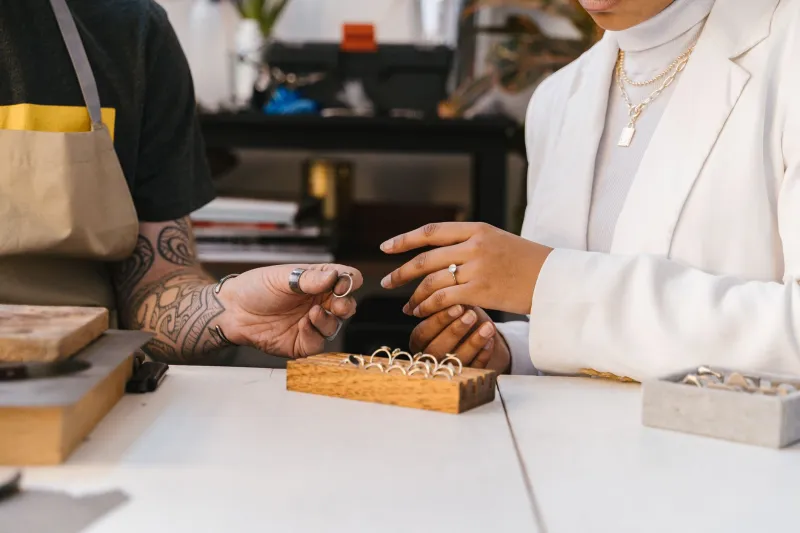
There is a particular kind of silence in a jeweller's workshop just before an engraver's tool meets metal. It is not hesitation so much as concentration. Everyone present understands that the next few minutes will outlast the occasion that prompted them. Engraving is the one alteration to fine jewellery and watches that cannot be undone without cost, compromise or a visible scar. Yet it is also the element most often decided in the final days before a birthday, an anniversary or Christmas Eve.
This article argues for the opposite approach. Not reluctance, and certainly not a refusal to personalise, but a slower, better-informed decision that treats the inscription as part of the piece rather than an accessory to the gift.
Why an Inscription Deserves a Second Visit
Most purchases in a jeweller's salon proceed at a civilised pace. A ring is tried, a chain is compared, a watch is fastened and unfastened several times. Engraving, by contrast, is frequently added at the till, chosen from a small card of examples and confirmed with a signature. The result is often perfectly pleasant. It is rarely the inscription the owner would have chosen after a week of thought.
A second visit, or at least a deliberate pause between deciding and commissioning, changes the quality of the outcome. It allows the wording to be tested aloud, the placement to be considered against the piece's proportions, and the question of visibility to be settled honestly. For a piece intended to mark a milestone, that pause is not indecision. It is care.
The Words: Fewer Usually Carry More
The strongest inscriptions tend to be short. Initials, a date, a single word, a pair of names, a set of coordinates, a line of four or five words at most. Length is not the enemy of meaning, but it is the enemy of legibility on a ring band two millimetres wide, and it is often the enemy of good judgement as well.
A useful test is to ask whether the words will still sound right in fifteen years. Private jokes and contemporary slang tend to age less gracefully than a date or a name. So do declarations that depend on a particular phase of a relationship. This is not an argument for blandness. A short, strange, specific phrase can be far more affecting than a standard endearment, provided it is chosen with the same seriousness as the setting itself.
Dates deserve particular scrutiny. Check the year, the order of day and month, and the spelling of every name. Ask a second person to read the instruction back. Errors at this stage are expensive to correct and impossible to hide.
Two Registers: Hidden and Visible
One of the most useful distinctions in engraving is between messages meant for the world and messages meant for the wearer. Visible inscriptions, on the outer band of a ring or the face of a locket, are declarations. Hidden inscriptions, inside a band, on the reverse of a pendant or beneath a watch clasp, are private correspondence carried in plain sight.
Both have their place, but they behave differently. A hidden message is protected from comment and from changing taste. It is also less constrained by space, since it is not required to look decorative. A visible inscription, by contrast, becomes part of the design and should be judged as such. On a slim band, a line of text can overwhelm the metal; on a wide signet or a substantial bangle, it can sit comfortably.
The choice often reveals what the giver actually intends. A message for the recipient alone is usually better hidden. A message intended to be seen, such as a wedding date, may belong on the outside. Confusing the two is one of the commonest sources of regret.
Placement and the Geometry of Regret
Jewellery is altered over a lifetime. Rings are resized, chains are shortened, clasps are replaced. Each of these operations removes or adds metal, and engraving near a joint or a sizing line can be lost in the process. A competent jeweller will know where an inscription can safely sit and where it cannot.
Ring bands present the clearest constraints. A band that is likely to be resized by more than a size or two may lose an inner inscription altogether. Bangles and cuffs have thin sections where a deep cut can weaken the structure. Lockets have hinges and rims that must remain clear. Watches have their own rules, discussed below. The general principle is simple: engraving should follow the architecture of the piece, not fight it.
Typeface, Technique and the Question of Depth
Hand engraving, laser engraving and machine engraving produce visibly different results. Hand engraving cuts a bright, variable line with a characteristic rhythm and is often the most sympathetic to older or more traditional pieces. Laser engraving is precise, shallow and well suited to very small text or to surfaces that cannot tolerate a cutting tool. Machine engraving sits between the two and varies considerably in quality.
The typeface matters as much as the method. A flowing script can be beautiful on a locket and illegible on a narrow band. A clean serif or a restrained block lettering often wears better over decades and photographs more clearly for insurance records. Where the piece has a historical character, a period-appropriate letterform will look intentional rather than applied.
Ask to see examples of the engraver's work on a similar surface, not simply on a flat sample plate. Curved surfaces and small areas reveal skill quickly.
The Watch Case: A Separate Caution
Watch engraving deserves its own paragraph because the stakes are different. The caseback is thin, the movement sits close beneath it, and water resistance depends on seals and tolerances that should not be disturbed casually. A skilled engraver can work on many casebacks without issue, but the decision should be made with the watch's service history and warranty position in mind.
For vintage or collectable watches, an external inscription can materially reduce value. In such cases, a message inside the caseback, on the clasp or on a discreet plaque is often the wiser course. If the watch is under manufacturer warranty, confirm the position before any tool is used. A permanent mark made in the wrong place is a difficult conversation with a service centre.
What It Means at Resale
Personalisation narrows the market. That is not a reason to avoid it, but it is a reason to choose the wording with the future in mind. A piece engraved with a full name and a date is a piece for one person or one family. A piece engraved with initials, a single date or nothing at all remains open to others.
For heirloom pieces, the calculus shifts. An inscription can add provenance, linking an object to a person and a moment, and that history is precisely what makes an heirloom worth keeping. The distinction is between personalisation that tells a story and personalisation that merely labels an object.
Working With the Jeweller
Bring the piece, not a photograph of it. Discuss the wording, the placement and the method in the same conversation. Ask who will do the work and whether it is done on the premises. Request a paper proof or a taped outline on the piece itself for anything longer than a few characters. Confirm the turnaround, particularly in November and December.
If the item is newly purchased, check the exchange policy before commissioning engraving; many retailers treat personalised pieces as final sale. If the item is second-hand or inherited, ask the jeweller to assess whether the surface can take the cut without losing the hallmark or thinning a structural area. In the UK, hallmarks must remain legible, and no engraving should compromise them.
A Checklist Before the Tool Touches Metal
- Read the wording aloud, then read it backwards.
- Confirm every name, date and initial against a written source.
- Decide whether the message is for the wearer or for an audience.
- Ask where the piece may be resized or repaired in future.
- View examples of the engraver's work on a curved surface.
- Confirm the hallmark will remain clear and undisturbed.
- Check the retailer's policy on personalised returns.
- Allow more time than you think the job requires.
The Longer View
An inscription is a small thing, but it is a permanent one. It sits at the intersection of sentiment and craft, and it deserves the same consideration as the stone, the metal or the movement. Chosen slowly, it becomes part of the piece's character. Chosen hastily, it becomes a reminder of haste.
The most persuasive argument for considered engraving is not that mistakes are costly, though they are, but that a well-chosen line grows better with time. It acquires weight as the years pass and the occasion recedes. That is the quiet advantage of taking a little longer now.